The AI Cloud Reset: Why Enterprises Are Moving Production AI to Private Infrastructure in 2026
The first wave of enterprise AI experimentation moved quickly into public cloud platforms. Production AI is forcing a different conversation. Cost predictability, data privacy, governance, latency, integration, and operational control are pushing many organizations toward private and hybrid infrastructure.
Why trust this analysis: Advanced Consulting Enterprises (CompuAce) has supported Florida businesses since 1984. Our senior consultants help organizations evaluate cloud strategy, cybersecurity posture, and infrastructure readiness for AI adoption across healthcare, legal, financial services, and ERP-driven operations.
Enterprise AI has entered a new phase. During the first wave, companies were trying to understand what generative AI could do. Teams created prototypes, tested copilots, experimented with retrieval-augmented generation, and accessed GPU resources through public cloud platforms.
That approach made sense. Public cloud gave innovation teams immediate access to infrastructure, managed services, APIs, foundation models, and flexible compute without waiting for a major capital project.
But experiments and production systems behave differently. A pilot may run for a few weeks with a limited dataset and a small group of users. A production AI platform may operate continuously, process proprietary information, connect to core business systems, serve hundreds or thousands of employees, and require documented controls around security, availability, cost, and compliance.
That transition is driving what we call the AI cloud reset: a reassessment of where enterprise AI workloads should run and how private cloud, public cloud, edge infrastructure, and existing data centers should work together.
What Is the AI Cloud Reset?
The AI cloud reset is not a wholesale rejection of public cloud. It is the shift from assuming that every AI workload belongs in public cloud to evaluating workload placement based on business requirements.
Broadcom's 2026 Private Cloud Outlook reports that 56% of surveyed enterprise IT leaders currently run or plan to run production AI inference in private cloud. The same report places public-cloud use for production inference at 41%, compared with 56% in the prior year. It also reports that 62% of respondents are very or extremely concerned about infrastructure costs associated with generative and agentic AI.
Those numbers deserve context. The study was commissioned by a major private-cloud vendor, and its respondents worked at organizations with at least 1,000 employees. The results should not be interpreted as proof that every company should build private AI infrastructure. They do, however, highlight a real strategic change: as AI moves into production, infrastructure decisions are becoming more deliberate.
The enterprise question is no longer "How quickly can we test AI?" It is "Where can we operate AI securely, predictably, and at a sustainable cost?"

Why Enterprise AI Started in Public Cloud
Public cloud was the natural starting point for the first generation of enterprise AI. It reduced the time between an idea and a working prototype. Public cloud platforms offered immediate access to:
- GPU and accelerated computing resources
- managed foundation-model services
- AI development tools and APIs
- object storage and data pipelines
- autoscaling infrastructure
- managed databases and vector search
- security, identity, and observability services
For a business exploring document summarization, customer-support automation, internal knowledge search, coding assistance, or predictive analytics, this model avoided a large upfront infrastructure commitment.
Public cloud remains an excellent option for variable workloads, rapid experimentation, globally distributed applications, managed AI services, and organizations that do not want to operate specialized hardware. The reset is not occurring because public cloud failed. It is occurring because AI workloads are maturing.
Why Production AI Changes the Infrastructure Equation
Production AI introduces sustained demand and operational responsibility. A system that influences customer service, fraud detection, document review, medical administration, financial analysis, or internal decision-making cannot be managed like an isolated lab. Production AI may require:
- consistent inference performance
- controlled access to sensitive data
- integration with business databases and applications
- documented retention and audit policies
- high availability and disaster recovery
- predictable monthly operating costs
- continuous monitoring and incident response
- model, prompt, and data governance
Once these requirements appear, workload placement becomes an architecture decision rather than a procurement shortcut.

Cost Predictability Is Driving the Private AI Conversation
AI infrastructure can be expensive regardless of where it runs. Public cloud transfers capital expense into operating expense, but that does not automatically make a workload less expensive. Variable cloud pricing is attractive when demand is uncertain. Sustained, high-utilization workloads can produce a different economic profile.
Common AI cost drivers include GPU instance time, data storage and replication, model endpoints and token consumption, cross-region or internet data transfer, backup retention, logging and observability, security tooling, development and test environments, and idle or oversized resources.
Private infrastructure can make sense when utilization is stable, hardware can remain productive for an appropriate lifecycle, and the organization has the operational capability to manage it. But private cloud also carries real costs: hardware acquisition, data-center space, electricity, cooling, networking, platform licensing, staffing, maintenance, spare capacity, and eventual replacement.
A credible comparison must calculate total cost of ownership across several years. It should not compare a public-cloud monthly bill with the purchase price of a server.
Data Privacy, Security, and Governance Are Pulling AI Closer to Enterprise Data
Many enterprise AI systems depend on information that organizations cannot treat casually: contracts, customer records, internal communications, financial data, intellectual property, support tickets, medical information, or proprietary operational data.
Private and hybrid architectures can give organizations more control over where data resides, how traffic moves, which models can access it, and how activity is monitored. That control may be especially relevant for healthcare, financial services, legal, insurance, manufacturing, government contractors, and other organizations with strict confidentiality or regulatory obligations.
Private infrastructure does not automatically make AI secure. A poorly configured private environment can be less secure than a well-managed public-cloud environment. Security depends on architecture and operations — identity and role-based access control, MFA, network segmentation, encryption in transit and at rest, secrets management, data classification and loss prevention, model and API logging, patch management, backup and ransomware resilience, and incident response.
Performance, Latency, and Integration Favor Infrastructure Close to the Data
Some AI use cases require low latency or frequent access to large enterprise datasets. Moving data repeatedly between local systems and remote cloud services may introduce delay, transfer cost, architectural complexity, or security concerns. Private or edge infrastructure may provide advantages for real-time manufacturing analysis, computer vision near operational equipment, high-volume document processing, AI systems connected to local databases, latency-sensitive customer applications, and environments with limited external connectivity.
Public cloud may still be the stronger option when global reach, elastic capacity, managed AI platforms, rapid innovation, or access to specialized services matters more.
Private Cloud vs. Hybrid Cloud: The Real Answer Is Often "Both"
The phrase "moving AI back on-premises" oversimplifies what enterprises are doing. Many are not abandoning public cloud. They are building hybrid operating models. A hybrid AI architecture might use public cloud for experimentation and short-term GPU bursts, private cloud for sustained inference against sensitive data, SaaS AI for standardized productivity tasks, edge systems for latency-sensitive operations, and public-cloud backup or disaster recovery.
Hybrid cloud can give a business flexibility, but it also increases management complexity. Identity, networking, monitoring, security policy, data movement, and cost allocation must remain consistent across environments. The objective is not to maximize the amount of private cloud or public cloud. It is to create the correct operating model for each workload.
Which AI Workloads Belong in Public, Private, or Hybrid Infrastructure?
| Workload Characteristic | Likely Starting Point | Reason |
|---|---|---|
| Short-term prototype with uncertain demand | Public cloud | Fast deployment and minimal upfront commitment |
| Sustained inference with predictable utilization | Private or hybrid cloud | Potential for greater cost predictability and control |
| AI processing highly sensitive internal data | Private or tightly governed hybrid | Stronger control over data locality and access |
| Global customer-facing AI application | Public or hybrid cloud | Scalability, geographic reach, managed services |
| Factory-floor computer vision | Edge plus private/hybrid cloud | Low latency and local operational continuity |
| General employee productivity assistant | Enterprise SaaS AI | Lower implementation burden when governance is configured correctly |
This table is a planning guide, not a substitute for a technical, financial, security, and compliance assessment.
What Private AI Infrastructure Actually Requires
Private AI is not simply a rack of GPU servers. A production platform requires a complete operating environment — compute and accelerators sized to model type and concurrency; storage and data architecture spanning structured databases, object storage, vector databases, and backups; high-speed networking that accounts for bandwidth, latency, segmentation, and resilience; virtualization and container platforms combining VMs, Kubernetes, model services, and traditional applications; power and cooling capacity beyond what a standard server room may support; and observability and FinOps to keep expensive AI capacity from becoming idle or inefficient.
The SQL Server and Oracle Connection
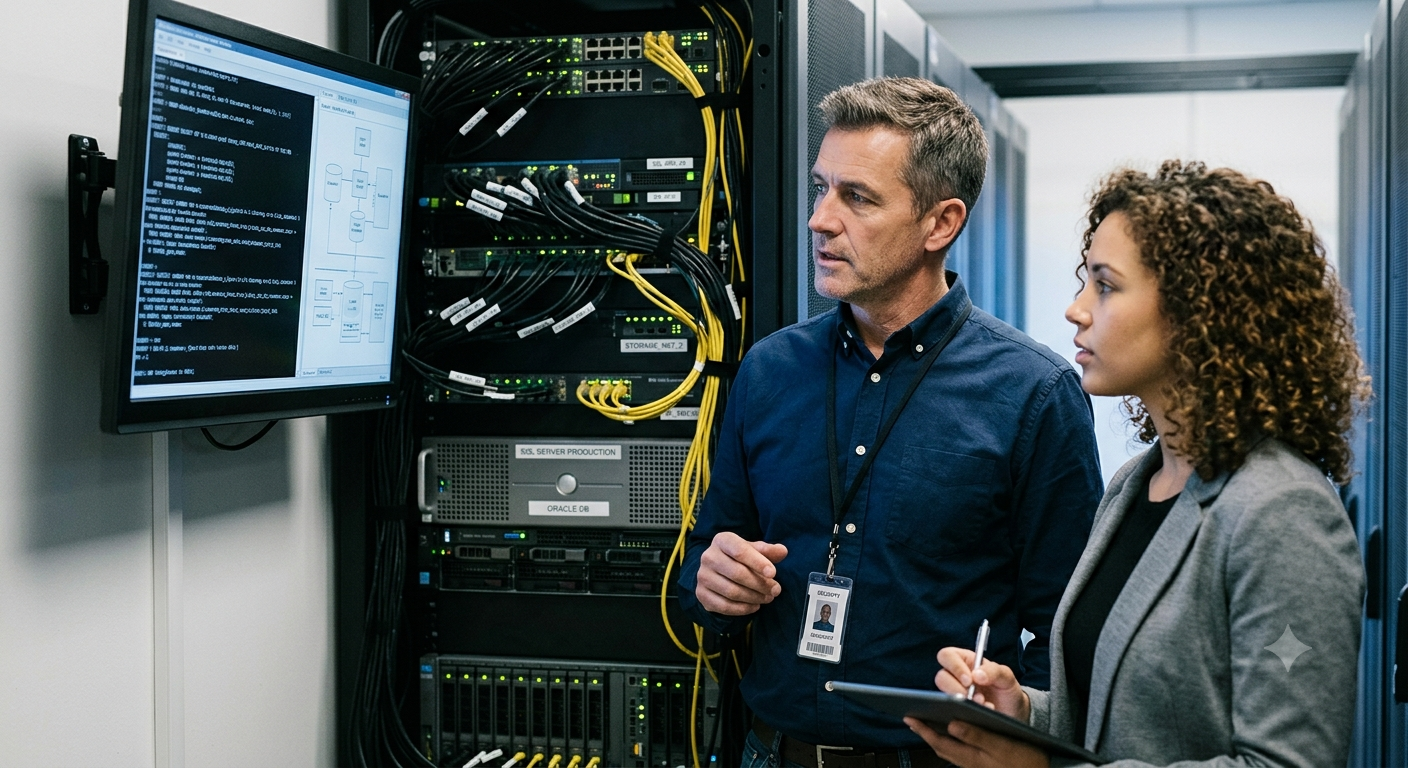
Many enterprise AI applications depend on existing databases rather than isolated data lakes. SQL Server and Oracle frequently hold the operational data required for reporting, forecasting, customer support, fraud analysis, and internal knowledge applications.
Connecting AI to production databases introduces important questions: Should AI query production systems directly? Is a replicated, masked, or read-only data layer required? How will PII be protected? Can current database infrastructure support additional demand? How will database and virtualization licensing be affected? What audit trail is required for AI-generated access?
Database performance tuning can also influence AI economics. Inefficient queries, oversized instances, poor indexing, or fragmented data pipelines can increase the compute required to support an AI use case. Before purchasing more infrastructure, businesses should verify that the database, integration, and storage layers are operating efficiently.
Private AI Risks Businesses Should Not Ignore
Private infrastructure provides control, but it also transfers responsibility to the organization or its managed service partner. Common risks include overbuying hardware as AI growth forecasts miss the mark; underestimating operational complexity across compute, storage, networking, virtualization, containers, cybersecurity, and facilities; creating a new infrastructure silo that duplicates identity, security, and monitoring tools already in place; ignoring business continuity for AI systems that influence operations; and assuming private means compliant — data location is only one part of compliance.
A Practical AI Infrastructure Readiness Framework
- Define the business use case. Identify the operational problem, target users, expected outcome, and measurable value. Do not begin with hardware.
- Classify the data. Determine whether the workload uses public, internal, confidential, regulated, or highly sensitive information.
- Model demand. Estimate user volume, request frequency, concurrency, model size, latency targets, data growth, and expected utilization.
- Compare deployment options. Evaluate enterprise SaaS AI, managed public-cloud services, private cloud, colocation, edge, and hybrid architecture.
- Calculate total cost of ownership. Include infrastructure, software, facilities, staffing, support, security, backup, data transfer, and lifecycle replacement.
- Design security and governance. Define identity, permissions, data boundaries, logging, retention, model access, human review, and incident response.
- Test with a controlled pilot. Validate performance, security, cost, integration, and user value before expanding.
- Establish ongoing operations. Assign responsibility for patching, monitoring, capacity management, model lifecycle, vendor management, and business continuity.
What the AI Cloud Reset Means for South Florida Businesses
South Florida organizations face the same enterprise AI decisions as companies across the country, with additional regional considerations around hurricane readiness, connectivity, power resilience, disaster recovery, and geographic continuity.
Healthcare providers, law firms, financial companies, insurance organizations, manufacturers, distributors, and professional-service firms in Miami, Miami Lakes, Doral, Coral Gables, and Fort Lauderdale may need a hybrid approach that balances cloud flexibility with strong control over critical systems and data.
Local infrastructure planning should consider backup power and facility readiness, off-site and cross-region recovery, network-provider redundancy, secure remote administration, data residency and regulatory obligations, cloud and on-premises integration, and managed monitoring and incident response.
How CompuAce Helps Businesses Build the Right AI Infrastructure Strategy
Founded in 1984, Advanced Consulting Enterprises, Inc. (CompuAce) has supported organizations through the PC, networking, virtualization, cloud, cybersecurity, and artificial intelligence eras. Our role is not to force every workload into one platform. It is to help businesses determine which architecture best supports their operational, financial, security, and compliance requirements.
CompuAce can assist with AI infrastructure readiness assessments, private and hybrid cloud architecture, public-cloud workload and cost reviews, VMware and Hyper-V infrastructure planning, Microsoft Azure and AWS integration, network, storage, and server modernization, SQL Server and Oracle performance optimization, cybersecurity and access-control reviews, backup and disaster recovery planning, and managed IT services and ongoing monitoring.
Explore related services:
Frequently Asked Questions
Why are enterprises moving production AI to private cloud?
Enterprises are evaluating private cloud for greater control over sensitive data, predictable performance, governance, integration, and potentially more predictable economics for sustained workloads. The right decision depends on the specific use case.
Is private cloud always cheaper than public cloud for AI?
No. Private cloud requires hardware, facilities, software, staffing, maintenance, security, and lifecycle investment. It may provide favorable economics for stable, highly utilized workloads, while public cloud may be more efficient for variable demand or rapid experimentation.
Does private AI mean all company data stays on-premises?
Not necessarily. Private AI may run in an on-premises data center, a hosted private cloud, a colocation facility, or a hybrid architecture. The defining requirement is controlled infrastructure and governance, not one physical location.
What is hybrid AI infrastructure?
Hybrid AI infrastructure combines private systems, public-cloud services, SaaS tools, and sometimes edge computing. Workloads are placed according to cost, security, performance, scalability, and data requirements.
Can private AI improve data security?
Private infrastructure can provide more control over data location, network paths, and access policies. It is not automatically secure. Strong identity, encryption, segmentation, monitoring, patching, backup, and governance are still required.
What should a business assess before building private AI infrastructure?
The business should assess use cases, data sensitivity, utilization, integration, security, compliance, facilities, staffing, disaster recovery, and total cost of ownership before selecting a platform.
Can CompuAce help with private and hybrid AI planning?
Yes. CompuAce helps businesses assess infrastructure readiness, compare deployment models, modernize systems, strengthen cybersecurity, optimize databases, and design private or hybrid cloud strategies.
Editorial and Source Note
The 2026 statistics referenced in this article originate from Broadcom's Private Cloud Outlook 2026, a vendor-sponsored survey of 1,800 senior IT decision-makers at enterprise organizations with at least 1,000 employees across eight countries. Survey findings are useful indicators of enterprise sentiment but should not replace an independent technical and financial assessment.
Is Your Infrastructure Ready for Production AI?
Moving AI from experimentation into production requires more than model selection. It requires a secure, resilient, cost-conscious infrastructure strategy. CompuAce can help your organization assess private cloud, public cloud, hybrid infrastructure, cybersecurity, database performance, and business continuity before you make a major investment.
Advanced Consulting Enterprises (CompuAce) — 15150 NW 79th Court, Suite #206, Miami Lakes, FL 33016 · (305) 623-0360 · Mon–Fri 9:00–18:00 ET.
Schedule an AI Infrastructure Assessment
By CompuAce Team —