How Businesses Can Use AI: Practical Applications for Modern Companies
Artificial intelligence is no longer just a futuristic concept or a tool reserved for large technology companies. Today, businesses of all sizes are exploring how AI can help improve productivity, reduce repetitive work, strengthen cybersecurity, support better decision-making, and create more efficient operations.
The challenge is that many business owners and managers still do not know where AI actually fits inside their organization. They hear about AI constantly, but they are not always sure how to use it in a practical, secure, and cost-effective way.
This guide explains the most realistic ways companies can use AI today, what benefits to expect, where the risks are, and how to approach AI adoption with a clear business strategy.
Why AI Matters for Modern Businesses
Businesses are under constant pressure to work faster, serve customers better, control costs, and protect sensitive information. AI can help address these challenges by automating routine tasks, identifying patterns in data, improving response times, and supporting employees with smarter tools.
For many organizations, the goal is not to replace people. The real value of AI comes from helping teams work more efficiently and make better decisions with the information they already have.
Companies that adopt AI strategically can improve operations without adding unnecessary complexity. The key is to focus on real business problems instead of chasing technology trends.
What Are the Most Practical Uses of AI in Business?
The best AI use cases are usually the ones that solve everyday operational problems. These applications may not always look dramatic, but they can create measurable improvements in productivity, service quality, security, and cost control.
1. AI for Customer Support and Client Communication
AI-powered support tools can help businesses respond to customers faster and more consistently. Chatbots, virtual assistants, and automated response systems can answer common questions, route requests, summarize issues, and support after-hours communication.
Common use cases include:
- answering frequently asked customer questions
- routing service requests to the right department
- summarizing customer interactions
- supporting appointment scheduling
- helping internal help desk teams manage requests
This allows employees to focus on complex issues that require human judgment while AI handles repetitive communication tasks.

2. AI for Administrative Work and Office Productivity
Many businesses spend significant time on administrative tasks that are necessary but repetitive. AI can help reduce the manual workload associated with documentation, reporting, scheduling, email drafting, and information organization.
Businesses can use AI to assist with:
- drafting emails and internal documents
- summarizing meetings and action items
- organizing notes and reports
- generating first drafts of business communications
- reviewing documents for clarity and consistency
- extracting key details from long files or conversations
These tools can help teams save time and reduce administrative bottlenecks without changing the entire way the business operates.
3. AI for Cybersecurity and Threat Detection
Cybersecurity is one of the most important areas where AI is already being used. Modern security platforms can analyze behavior, detect unusual activity, identify suspicious login attempts, and help security teams respond faster to potential threats.
AI can support cybersecurity by helping detect:
- phishing attempts
- unusual login behavior
- endpoint threats
- network anomalies
- potential malware activity
- unauthorized access attempts
AI does not replace a cybersecurity strategy, but it can improve visibility and help businesses identify risks earlier. This is especially valuable for small and mid-sized businesses that may not have large internal security teams.
4. AI for Data Analysis and Business Insights
Most businesses collect data, but many do not have the time or resources to analyze it effectively. AI can help identify trends, summarize performance, and reveal patterns that may be difficult to detect manually.
AI can assist with analysis of:
- sales trends
- customer behavior
- inventory patterns
- marketing performance
- financial reports
- operational inefficiencies
Better data analysis helps business leaders make more informed decisions and identify opportunities for improvement faster.

5. AI for IT Operations and Infrastructure Monitoring
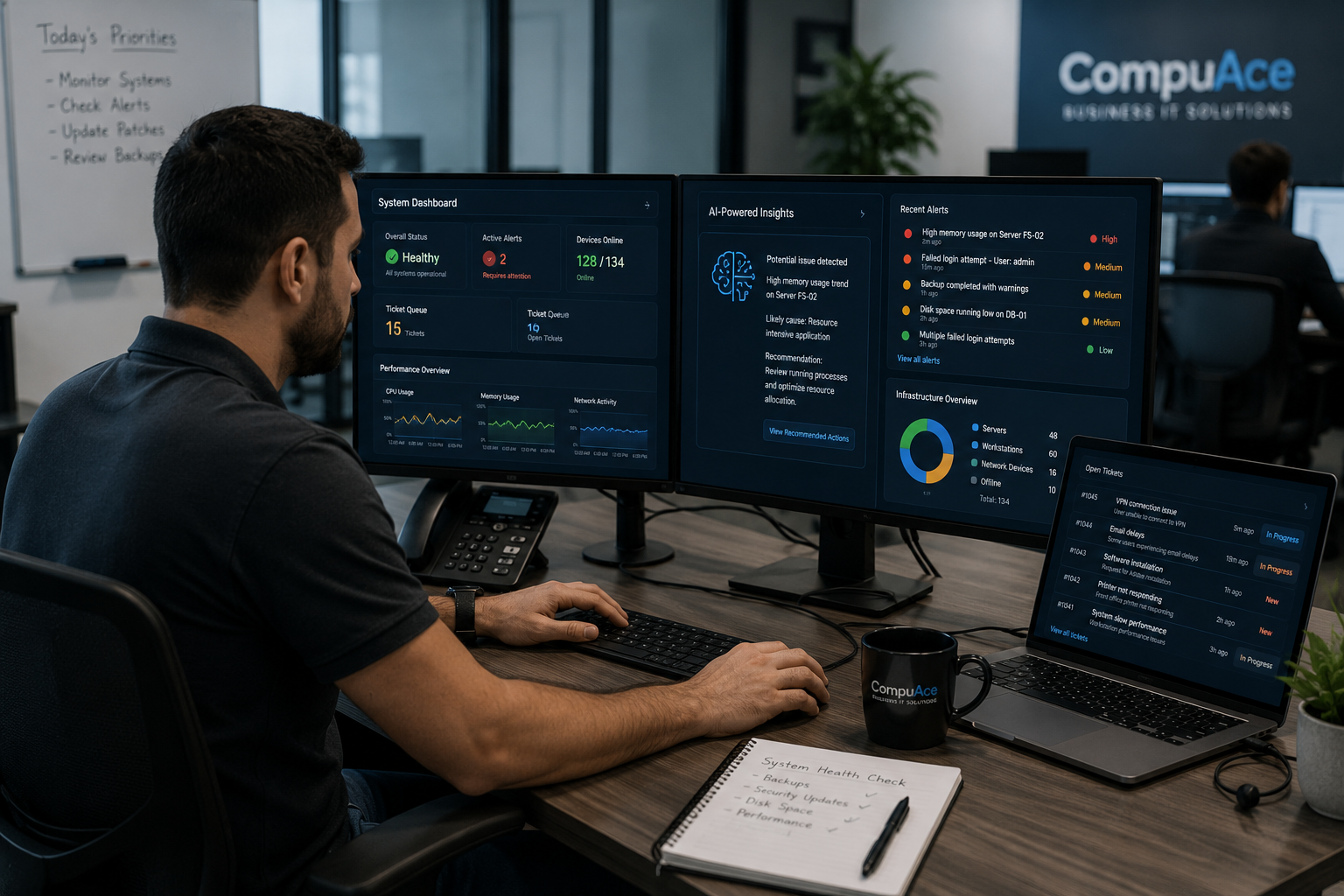
AI can also improve how businesses manage their technology environments. AI-assisted IT tools can monitor systems, detect performance issues, predict potential failures, and help prioritize technical support tasks.
Practical IT use cases include:
- monitoring network performance
- detecting system anomalies
- predicting hardware or software issues
- automating routine alerts
- optimizing cloud resource usage
- supporting help desk workflows
This helps businesses reduce downtime, improve response times, and maintain more reliable technology operations.
6. AI for Sales and Marketing Support
AI can help sales and marketing teams better understand prospects, personalize communication, and improve campaign performance. It can also support content planning, lead scoring, customer segmentation, and reporting.
Businesses can use AI to:
- analyze customer segments
- generate content outlines
- personalize email campaigns
- summarize lead activity
- identify sales opportunities
- review campaign performance
AI should not replace brand strategy or human relationship-building, but it can help teams operate more efficiently and respond with better information.
How Should Businesses Start Using AI?
The safest way to start with AI is to begin with clear business goals. Companies should avoid adopting AI tools simply because they are popular. Instead, they should identify specific problems that AI may help solve.
Start with Operational Pain Points
Businesses should begin by asking practical questions:
- Which tasks take too much employee time?
- Where do customers experience delays?
- Which reports are difficult to produce?
- Where are security risks increasing?
- Which workflows are repetitive or inconsistent?
These answers help determine where AI can deliver real value.
Choose Low-Risk AI Use Cases First
Early AI projects should be useful, measurable, and manageable. Good starting points include meeting summaries, internal documentation, customer support assistance, reporting, and IT monitoring.
These use cases allow businesses to build confidence before moving into more complex AI integrations.
Establish AI Policies and Governance
AI adoption must include clear rules for security, privacy, and employee usage. Businesses should define what information can and cannot be entered into AI tools, who has access, and how outputs should be reviewed.
Important governance areas include:
- data privacy
- access controls
- acceptable use policies
- employee training
- vendor evaluation
- human review of AI-generated work
Responsible AI use requires oversight. Businesses should treat AI as a powerful business tool, not an unsupervised decision-maker.
What Risks Should Businesses Consider Before Using AI?
AI can create major advantages, but it also introduces risks if used carelessly. Businesses should evaluate these risks before deploying AI tools across teams.
Data Privacy Risks
Employees may accidentally enter sensitive client, financial, legal, medical, or internal business data into public AI tools. This can create privacy and compliance concerns.
Accuracy and Reliability Issues
AI systems can produce incorrect or incomplete information. Human review is still necessary, especially for business-critical decisions, technical recommendations, legal content, financial analysis, or security-related tasks.
Cybersecurity Risks
AI tools can become part of the attack surface if they are connected to business systems without proper controls. Organizations should evaluate vendors, permissions, integrations, and monitoring requirements carefully. Learn more about AI as the new attack surface.
Overreliance on Automation
AI should support business teams, not replace judgment. Companies should avoid automating important decisions without review, accountability, and clear escalation procedures.
How AI Can Support Different Business Departments
AI can provide value across multiple departments when implemented correctly.
Operations
AI can help identify workflow delays, automate repetitive processes, summarize reports, and improve resource planning.
Customer Service
AI can assist with faster responses, support ticket routing, knowledge base searches, and after-hours customer communication.
Finance and Administration
AI can help review reports, identify trends, organize documents, and support forecasting processes.
Sales and Marketing
AI can assist with lead analysis, campaign planning, content support, customer segmentation, and performance summaries.
IT and Cybersecurity
AI can improve system monitoring, threat detection, ticket prioritization, endpoint protection, and infrastructure visibility.
Why AI Works Best with a Strong IT Foundation
AI tools depend on reliable systems, clean data, secure access, and stable infrastructure. If a business has outdated systems, weak cybersecurity, poor data organization, or limited visibility into its IT environment, AI adoption becomes more difficult and riskier.
Before expanding AI usage, businesses should review:
- network security
- endpoint protection
- cloud environments
- data backup and recovery
- identity and access management
- software integrations
- compliance requirements
A strong IT foundation makes AI safer, more useful, and easier to manage.
How CompuAce Helps Businesses Adopt AI Safely
CompuAce helps businesses evaluate technology needs, strengthen IT infrastructure, improve cybersecurity, and plan practical technology solutions. For companies exploring AI, the first step is not always choosing a tool. The first step is understanding where AI fits, what risks need to be managed, and how the organization can adopt AI safely.
Our team can help businesses assess current systems, identify practical AI opportunities, improve security controls, and create a technology roadmap that supports responsible innovation.
AI can be a powerful advantage, but only when it is supported by the right infrastructure, policies, and security strategy.
Frequently Asked Questions About AI for Businesses
How can small businesses use AI?
Small businesses can use AI for customer support, email drafting, meeting summaries, reporting, cybersecurity monitoring, administrative tasks, and marketing support. The best starting point is usually a repetitive task that consumes time but does not require complex decision-making.
Is AI only useful for large companies?
No. Many AI tools are now accessible to small and mid-sized businesses. AI can help smaller organizations improve productivity, reduce manual work, and make better use of existing data.
Can AI improve cybersecurity?
Yes. AI can help identify unusual behavior, detect threats, monitor endpoints, analyze suspicious activity, and improve response times. However, AI should be part of a broader cybersecurity strategy, not the only layer of protection.
What is the safest way for a business to start using AI?
The safest approach is to start with low-risk use cases, create clear usage policies, protect sensitive data, train employees, and ensure human review of AI-generated outputs.
Can AI replace employees?
In most business environments, AI is most useful as a productivity tool that supports employees rather than replaces them. It can reduce repetitive work and help teams focus on higher-value tasks.
Does AI require better IT security?
Yes. Businesses using AI should review access controls, data privacy, cloud security, endpoint protection, and vendor risks. AI adoption should always include security and governance planning.
Ready to Explore AI for Your Business?
CompuAce helps businesses evaluate AI opportunities, strengthen IT infrastructure, improve cybersecurity, and build practical technology strategies for growth.
If your organization is considering AI but is not sure where to start, our team can help you identify realistic use cases and create a secure adoption plan.
Schedule an AI and IT Strategy Consultation
By CompuAce Team —